
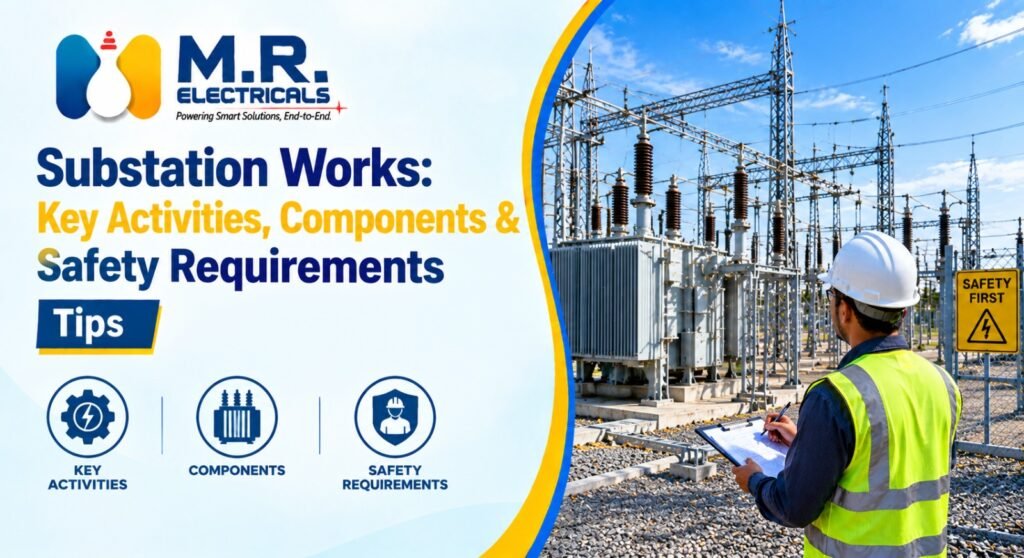
Why electrical substations Are important electrical substation work involves switching, controlling, and stepping up or down voltage to transfer power to and from a large number of homes, businesses, and infrastructure. Switch gear installations, transformer installation and replacement, electrical system protection, and other work performed at electrical substations demand both skilled workers and a safe working environment.
With knowledge of the essential components, critical tasks, and safety considerations for substation works, project managers, electrical engineers, contractors, and maintenance engineers can operate and maintain substations successfully.
What Are Substation Works?
Substation works include building installing testing commissioning inspecting, and maintaining electrical substations. These facilities may be designed for transmission networks, distribution systems, industrial plants, renewable energy projects, or large commercial developments.
A substation may be used to boost the voltage to allow efficient long distance transmission or step down the voltage for local distribution, according to its purpose. The amount of work involved depends on the voltage rating design capacity and the function of the substation.
1. Key Activities Involved in Substation Works
These list mentions the required activities that have to be done for setting up and operating a working substation.
Site Preparation and Civil Works
The civil part starts with sites study, soil surveys, foundation design, drain details and site access roads. Civil works can comprise among others of transformer foundations and supports, cable trenches, control room, boundary fence.
Before installation, site preparation allows for structurally sound installation, adequate drainage and safe access.
Equipment Installation
After the completion of civil works, electrical equipment is installed based on the approved engineering drawings and manufacturer instructions. The major installation involves transformers, circuit breakers isolators bus-bars, current transformers, and voltage transformers.
Before testing, thoroughly check the positioning clearance earth connections, and cable terminations of equipment.
Testing and Commissioning
Verification confirms correct functioning of equipment and protection, possibly including tests of insulation resistance, transformer tests, circuit breaker operation tests, relay tests, and control circuit verification.
Commissioning should not be undertaken until the tests, reports, records, and safety clearances have been examined.
Inspection and Maintenance
Periodic testing and inspection will allow you to discover any deterioration, loose connections, hot spots, oil leaks, corrosion, and other faults. Preventive maintenance will avoid unintentional breakdowns of the equipment.
2. Major Components of an Electrical Substation
The knowledge of principal parts helps to plan and implement the substation works in a proper way.
Power Transformers: power transformers transfer electrical power between circuits and provide voltage conversion within a system.
Circuit Breakers: they switch of electric current in case of faults or in specific switching conditions. This helps protect the machines and the electrical network.
Isolators and Earthing Switches: These can be used for isolation during maintenance under the specified conditions in their design. But isolators are not meant to break the load current as a normal operating feature.
Bus-bars: Bus bars are used for connecting incoming and outgoing electrical circuits of the electrical substation.
Current Transformers and Voltage Transformers: These are used to provide scaled electrical measurements for metering, monitoring, and protection relays.
Protection Relays and Control Panels: detect abnormal conditions and actuate protective processes. Control panels are also used for monitoring, switching, and operation of equipment.
Earth and Lightning Protection Systems Earthing systems are used to control fault currents and the risk of touch and step voltages, whereas lightning protection reduces the risks from lightning strikes and surges.
3. Essential Safety Requirements for Substation Works
With voltages present at the substation, high fault currents and the likelihood of electrical energy being stored in the electrical systems, safety must be the primary concern during all construction, testing, and maintenance.
Follow permit-to-work procedures: work must be authorized before it starts, and all relevant persons should be made aware of the scope of work, risks involved and what measures are being put in place to protect them.
Isolate and Check Equipment: use approved isolating techniques, isolate/lockout/tagout where necessary, and check for absence of voltage with suitable tested equipment. Discharge and earth where instructed by the approved procedure.
Employ suitable Personal Safety tools: this could include arc-rated gear, insulating gloves, safety shoes headgear eye gear, and specialized equipment, appropriate to the job and identified from the risk evaluation.
Maintain Safe Electrical Clearances: follow the specified approach distances for the relevant voltage, and use approved barriers, access controls, and switching procedures.
Isolation of other services: check earthing: Correct installation of temporary protective earths and final earthing carried out as approved safety procedure.
Emergency Reporting: Ensure workers are informed of how to make a report to raise alarm, the emergency communication system, location of the emergency equipment, location of first-aid facilities, provision of first aid, and electrical rescue procedures.
Live working work should be carried out only by approved and trained workers. Live work should be avoided when possible and only be performed by to be exact authorized techniques that are legal and technically justified.
4. Practical Tips for Efficient Substation Projects
Coordination must exist between engineering, civil works, electrical installation, testing, and safety before substation work can start.
- Examine approved drawings, specifications, and equipment manuals before commencing work.
- Check the new equipment for damage and confirm the ratings of the appliance are suitable for the project.
- Early on, make sure to plan out the cable routing, foundations for equipment and earthing arrangements.
- Keep accurate inspection records, test reports and commissioning files.
- Hold toolbox talks and job safety assessments before high-risk activities.
- Schedule preventive maintenance as manufacturer and applicable standards.
They minimize rework, boost teaming and support future equipment life.
Conclusion:
The substation job is an important part of ensuring that we deliver safe, reliable, and efficient electrical energy. Everything from civil works and installation of equipment to commissioning and maintenance require specialist technical work.
With an understanding of substation equipment and system construction, established engineering standards, and better electrical safety precautions, project teams will create more reliable operations and safer work environments. In addition, a strong plan, experienced workforce, proper documentation, and routine maintenance are critical elements of success.